Structural Drying and Dehumidification in Grapevine, TX
Surfaces dry fast; framing, subfloor and concrete do not. The drying team sets air movers and dehumidifiers to the class of loss and logs readings daily until the structure reaches the IICRC S500 dry goal.
(888) 527-9134Set up Grapevine structural drying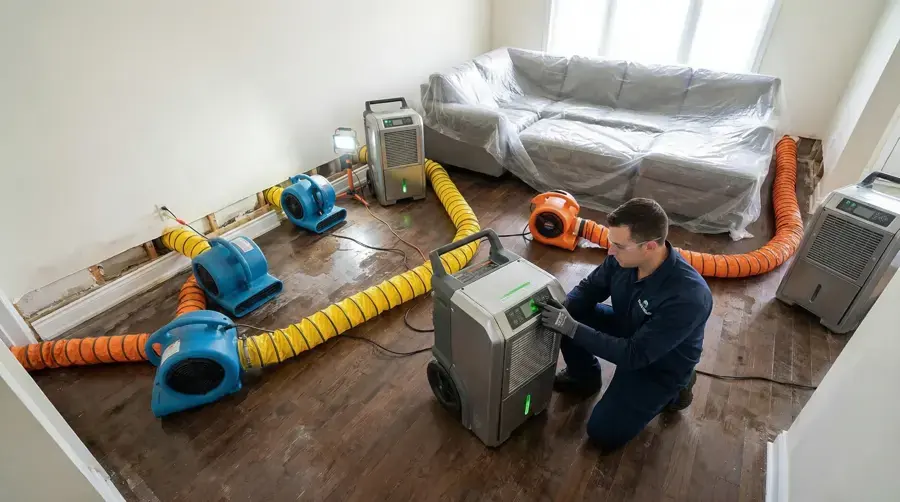
First steps for structural drying and dehumidification in Grapevine, TX
- 01Stop the source Make sure the leak is repaired or shut off before drying starts.
- 02Run the AC, not the heat Keeping the home cool with the air conditioner running helps pull moisture from the air.
- 03Open closets and cabinets Let air reach closets, vanities and cabinets that held water.
- 04Leave the equipment running Air movers and dehumidifiers work around the clock; switching them off sets the drying back.
Structural drying is the part of water damage restoration that decides whether the job lasts. Water soaks into studs, plates, subfloor, hardwood and the slab, and those materials keep holding it long after the surface feels dry. The drying team measures the moisture, sets the equipment to match, and keeps it running until readings prove the structure is dry.
What does structural drying and dehumidification cost in Grapevine, TX?
In Grapevine, TX, structural drying typically runs $1,200 to $8,000, depending on the class of loss, the number of rooms and how long dense materials such as hardwood or concrete need.
One room, Class 1 or 2
- Air movers and an LGR unit
- Daily readings
- Drying log
Several rooms, Class 3
- Wall and ceiling cavities dried
- Several dehumidifiers
- Psychrometric monitoring
Class 4: hardwood, plaster or slab
- Desiccant or floor drying systems
- Longer equipment time
- Full drying log for the claim
These are typical ranges, not a quote. The water category, the wet square footage, the material class and how soon drying started move the final number most.
Run the Grapevine water damage cost calculatorHow structural drying and dehumidification is handled in Grapevine
Measure
The tech who does the walkthrough maps moisture in every material and sets dry references from unaffected areas.
Plan by class
The drying team sizes air movers and dehumidifiers to the class of loss and the room volume.
Dry and monitor
Equipment runs around the clock while readings and psychrometric conditions are logged daily.
Verify dry
Equipment comes out only when every material reads within 2 to 4 points of its dry reference.
Class of loss sets the equipment
The IICRC S500 standard sorts losses by how much water the materials absorbed:
- Class 1: a small area with little absorption, mostly low-porosity materials
- Class 2: a whole room, with carpet and the bottom of the walls wet
- Class 3: water from above, with walls soaked high and ceilings wet
- Class 4: dense materials such as hardwood, plaster and concrete that hold water tightly
Higher classes need more air movement and more dehumidification, and Class 4 often calls for desiccant dehumidifiers that keep working at low humidity.
How the drying is controlled
Air movers push air across wet surfaces to speed evaporation, and dehumidifiers pull that moisture out of the air before it settles back into the materials. Psychrometric readings, which track temperature and humidity, show whether the drying conditions are working.
North Texas humidity matters here. Humid spring and summer air slows evaporation, so LGR dehumidifiers keep the drying area dry even when the air outside is not. The EPA indoor air quality pages explain why indoor moisture control matters.
Knowing when it is dry
Dry is a number, not a feeling. Each material is compared with a dry reference of the same material in an unaffected part of the home, and drying continues until it reads within 2 to 4 points of that reference.
Every reading goes into the drying log for the claim file. The drying time estimator shows a typical window, and Energy Saver from the Department of Energy covers dehumidifier efficiency at home.
Structural Drying and Dehumidification across Grapevine and northeast Tarrant County
Service runs across ZIP 76051 and 76099: Historic Main Street and Original Town, the College Street district, Silver Lake Estates and the Dove Road side near the lake, Western Oaks, Hidden Lake Estates, and the south side along Hall-Johnson Road and Glade Road.
Nearby coverage reaches Southlake, Colleyville, Coppell, Euless, Bedford, Flower Mound, Trophy Club and Irving.
Every Grapevine neighborhood and ZIP coveredRelated water damage services in Grapevine
Structural Drying and Dehumidification questions in Grapevine, TX
Water still moving in Grapevine?
Walls or floors still wet in Grapevine? The drying team sets up 24/7.
(888) 527-9134 Book Grapevine structural drying nowWhy does drying take several days?
Water moves out of studs, subfloor and concrete slowly, and pulling it out too fast can crack or warp materials. Controlled drying takes days, not an afternoon.
What is the difference between LGR and desiccant dehumidifiers?
LGR, or low grain refrigerant, units cool the air to condense water and suit most homes. Desiccant units use a drying wheel and work better in cool conditions and on dense Class 4 materials.
Can the equipment be turned off at night?
It should stay on. Drying works around the clock, and switching equipment off lets moisture settle back into the materials.
Why are holes drilled in the wall?
Small holes at the bottom of a wall let dry air into the cavity, so studs and insulation can dry without removing the drywall.
How is dry decided?
Each material is compared with the same material in a dry part of the home. Drying continues until it reads within 2 to 4 points of that reference.
Does drying take longer in summer?
Humid weather can add drying days, which adds equipment time. The drying time estimator shows how the season changes the window.
Still wet in Grapevine?
Surface-dry is not dry. The drying team sets equipment to the class of loss and logs readings until the structure meets the dry goal.
(888) 527-9134Grapevine drying team, 24/7